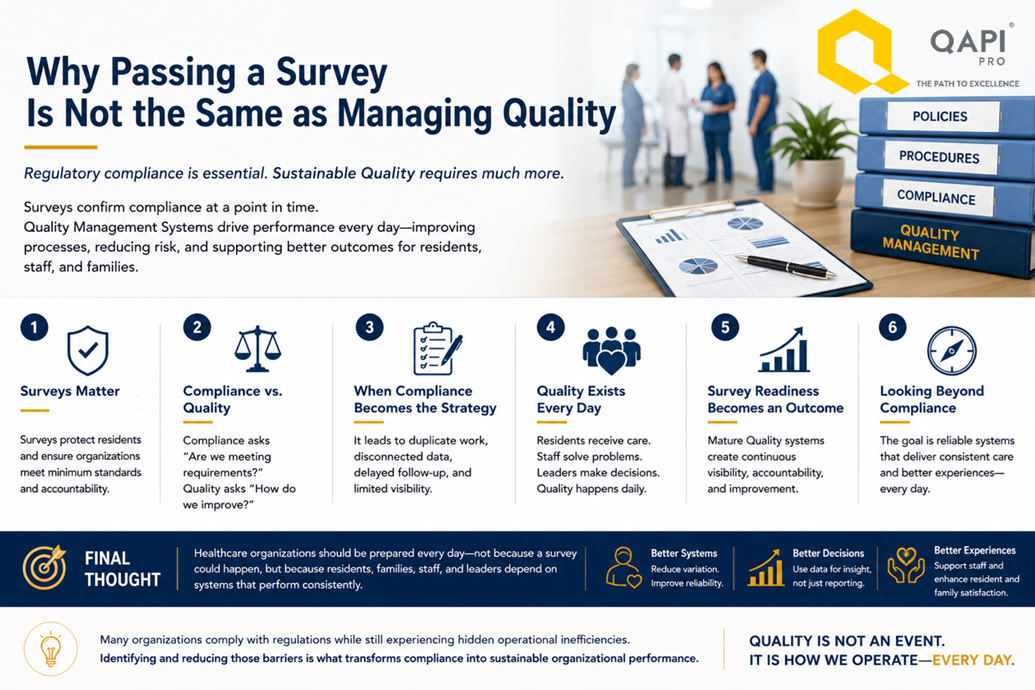
Regulatory compliance is essential. Sustainable Quality requires much more.
Every healthcare organization understands the importance of regulatory surveys. They establish minimum standards, promote accountability, and help protect residents and patients by verifying that care and services meet established requirements.
Maintaining compliance is not optional. It is a fundamental responsibility of every healthcare organization.
At the same time, compliance alone does not define organizational performance.
An organization may successfully complete a survey while still experiencing recurring operational issues, inconsistent processes, delayed follow-up, fragmented information, or unnecessary burden on frontline staff. Those conditions may not always result in immediate citation, but they influence the consistency, efficiency, and reliability of care every day.
That distinction matters because compliance and Quality, while closely related, serve different purposes.
Compliance Confirms Expectations. Quality Improves Performance
Regulatory compliance answers important questions:
- Are required standards being met?
- Is documentation complete?
- Have corrective actions been implemented?
- Can the organization demonstrate adherence to regulations?
These questions establish accountability and should remain an essential component of every healthcare organization.
A Quality Management System asks additional questions that focus on organizational performance:
- Why did this issue occur?
- How frequently does it happen?
- Which process contributed to the outcome?
- Where are patterns beginning to emerge?
- How can recurrence be prevented?
- What information does leadership need before performance declines?
Compliance verifies whether expectations have been met.
Quality Management improves how the organization performs over time.
Those are complementary objectives, but they are not interchangeable
When Compliance Becomes the Primary Strategy
Organizations that concentrate most of their efforts on survey preparation often develop workflows designed primarily to demonstrate compliance.
Over time, this can lead to operational practices such as:
- Multiple spreadsheets tracking similar information.
- Duplicate documentation maintained for different purposes.
- Corrective actions that receive attention immediately after surveys but lose momentum afterward.
- Meetings focused primarily on reviewing findings instead of improving systems.
- Departmental information that remains disconnected from broader organizational decision-making.
- Leaders spending more time collecting information than using it.
None of these activities necessarily indicate poor intentions.
In many cases, they reflect the gradual accumulation of processes added over years to satisfy individual requirements without being integrated into a cohesive Quality Management System.
As complexity increases, staff members often carry a growing administrative workload while leadership has less operational visibility than expected.
Quality Exists Every Day
Residents do not experience Quality only during survey weeks.
Staff members do not encounter operational challenges only when auditors are present.
Leadership decisions are not limited to regulatory review periods.
Quality influences every admission, every medication pass, every handoff, every care conference, every environmental round, and every interaction with residents and families.
Because healthcare operates continuously, Quality Management must also operate continuously.
An effective Quality Management System provides leaders with ongoing visibility into organizational performance, allowing risks, trends, and opportunities for improvement to be identified before they develop into larger operational or regulatory concerns.
Continuous Readiness Reflects Operational Maturity
Organizations with mature Quality systems rarely need to shift into a special "survey mode."
Their preparation occurs through everyday operational discipline.
Performance is monitored consistently.
Improvement activities continue throughout the year.
Departments communicate using shared information.
Leadership reviews meaningful indicators instead of isolated events.
Corrective actions become part of routine management rather than temporary projects.
Survey readiness becomes the natural outcome of reliable systems working as intended.
Looking Beyond Compliance
Regulatory compliance will always remain an essential responsibility.
Healthcare organizations should never view Quality and compliance as competing priorities. They strengthen one another when supported by an integrated management system.
The broader objective, however, extends beyond passing the next survey.
It is to create an organization where reliable processes support consistent care, informed leadership decisions, engaged staff, and better experiences for residents and families every day.
When Quality becomes part of daily operations rather than a response to regulatory events, compliance is no longer the destination.
It becomes one of many indicators that the organization's systems are performing as they should.
From Compliance to Performance
Healthcare organizations should strive to be prepared every day—not because a survey could happen tomorrow, but because residents, families, staff, and leaders depend on systems that perform consistently every day.
The strongest organizations are not defined solely by their ability to demonstrate compliance.
They are distinguished by their ability to build systems that continuously improve performance.