Reliability Does Not Begin Under Pressure
Reliable operations do not emerge when expectations increase.
They are established through systems that function consistently under normal conditions.
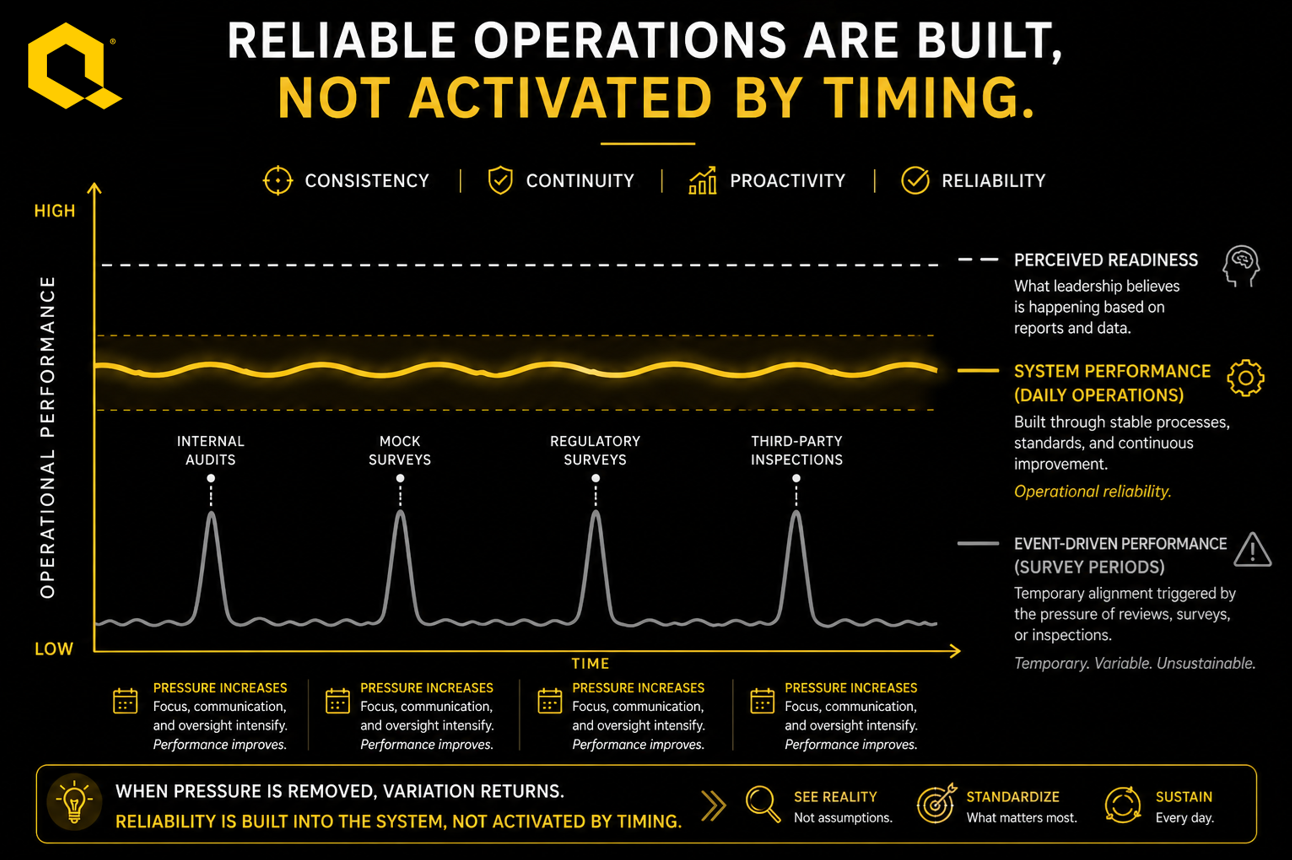
In healthcare operations, performance improves when attention intensifies, such as during internal audits, mock surveys, or external regulatory inspections.
Processes tighten.
Communication increases.
Expectations are reinforced.
For a period of time, operations appear aligned.
This is often interpreted as strength.
But alignment driven by timing is not the same as operational reliability.
When Visibility Is Limited, Perception Takes Over
It is reasonable to believe that operations are functioning as expected when:
- Reports are reviewed
- Data is analyzed
- Updates are shared across departments
On paper, everything appears aligned.
But without direct and continuous visibility into how work is performed, this perception is often incomplete.
When internal audits and mock surveys are implemented with depth, a different picture often emerges:
- Processes vary across shifts
- Documentation does not consistently reflect actual practice
- Critical information is delayed, missed, or not acted upon
The issue is not effort.
The issue is that decisions are being made based on partial visibility.
And partial visibility cannot produce consistent outcomes.
The Pattern of Event-Driven Performance
When visibility is limited and systems are not stable, a predictable pattern develops.
Performance improves when pressure is introduced, particularly in preparation for surveys, audits, or external evaluations.
Alignment increases when expectations are reinforced.
But once that pressure is removed, variation returns.
Processes begin to drift.
Execution becomes inconsistent again.
This is not a behavioral issue.
It is a system reliability issue.
Because systems that are not stable cannot sustain performance, they can only produce temporary alignment.
Performance Can Be Activated—Reliability Cannot
Short-term performance can be achieved through urgency, oversight, and reinforcement.
Reliability cannot.
Reliable operations:
- Do not depend on timing
- Do not depend on increased supervision
- Do not depend on reminders tied to upcoming events
They depend on:
- Defined processes
- Standardized execution
- Continuous auditing
- Consistent follow-through
This is the function of QAPI:
to operationalize Quality Assurance and Performance Improvement through stable, consistent systems.
Not to elevate performance temporarily,
but to ensure that operations produce the same results every day, whether or not observation is expected.
Consistency Is a System Output
Consistency is often treated as a reflection of effort.
It is not.
Consistency is the result of systems that:
- Make expectations clear
- Reduce variation
- Detect breakdowns early
- Reinforce execution continuously
Without these elements, variability is inevitable.
And when variability is present, reliability cannot be assumed, even if performance appears strong during periods of review.
From Perception to Control
Closing the gap between what is believed and what is actually happening requires more than reporting.
It requires control over how processes function in real conditions.
This is achieved through:
- Direct observation
- Structured internal auditing
- Validation of practice, not just documentation
- Timely response to identified gaps
Visibility is not about collecting more data.
It is about ensuring that data reflects reality, not just performance during periods of heightened attention.
A Leadership Standard
The question is not whether performance can improve under pressure.
Organizations can demonstrate strong performance during surveys, audits, or external evaluations.
The question is whether operations produce sustained results when that pressure is not present.
That is the standard of reliability.
And reliability is not activated.
It is built into the system.
Closing Perspective
When operations depend on timing, results will vary.
When operations are built on structured systems, results stabilize.
Quality is not demonstrated during periods of observation.
It is demonstrated in the consistency of daily execution—before, duing, and after any review.
And when that consistency is present, external validation becomes a confirmation—not a trigger.