

Reactive vs Proactive Quality
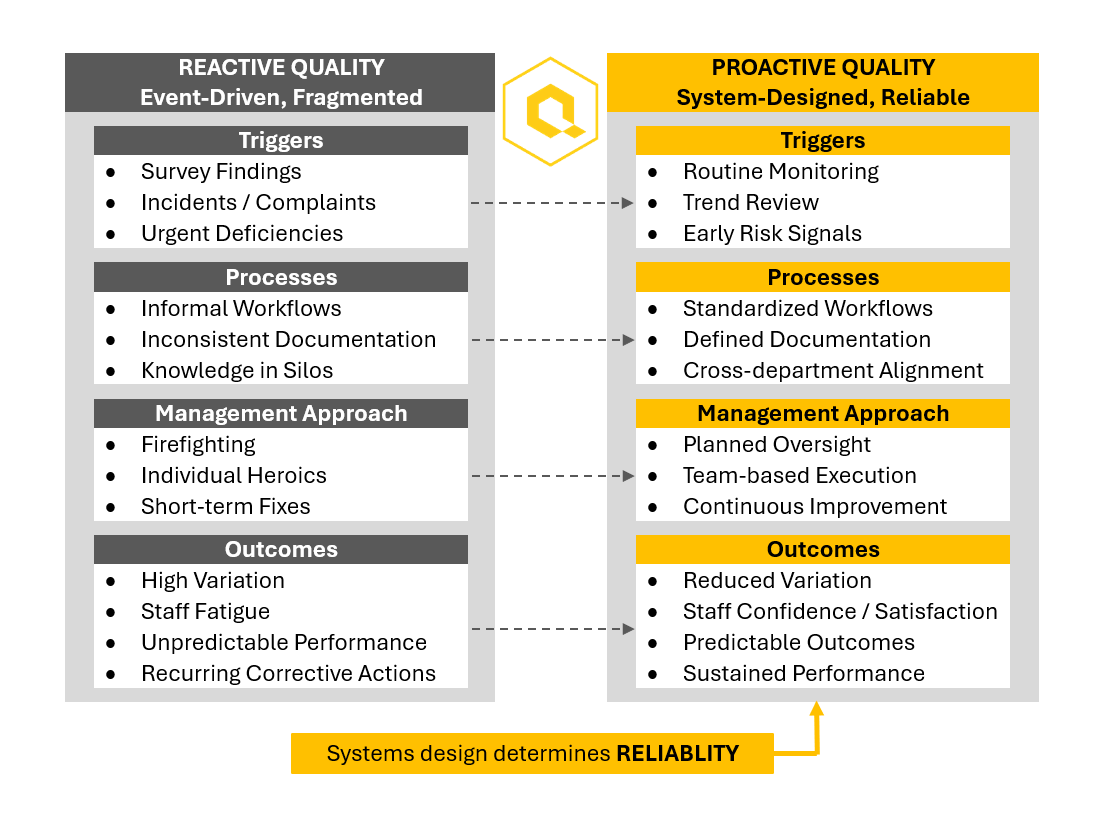


Reactive vs Proactive Quality in Nursing Homes: Why Systems, Not Effort, Determine Outcomes.
In today’s nursing home environment, the work we do every day is meaningful, but the way that work gets done has become increasingly complex. Clinical care, regulatory requirements, staffing pressures, and operational demands converge daily, often at the same time.
Complexity itself is not the problem; the challenge arises when complex work is managed without disciplined systems.
Reactive Quality: A Common, Costly Pattern
Many nursing facilities operate in a reactive quality mode, not by choice, but by default. Issues are addressed after an adverse event occurs, after a complaint is filed, or after a survey identifies gaps.
In reactive environments, quality work is driven by urgency rather than design. Leadership time is consumed by corrective actions, staff experience quality as pressure rather than support, and improvement efforts struggle to gain traction. Effort increases, but reliability does not.
Over time, this pattern becomes normalized.
Why Effort Alone Is Not Enough
In nursing homes, outcomes are shaped less by isolated clinical decisions and more by how consistently teams assess, document, communicate, and follow through across shifts, disciplines, and time.
When these processes are informal, inconsistently applied, or poorly monitored, variation becomes the norm. That variation erodes operational reliability, undermines staff confidence, and negatively impacts on the resident and family experience.
Strong teams cannot overcome weak systems indefinitely.
Proactive Quality Is Designed, Not Declared
Proactive quality does not happen organically. It is designed.
It requires:
- Clearly defined and standardized processes
- Consistent documentation and communication workflows
- Routine measurement and review of performance
- Leadership visibility, accountability, and follow-through
Without these elements, quality remains episodic, activated during surveys or crises rather than embedded into daily operations.
Reframing the Role of Quality
Quality is not an isolated department, a binder on a shelf, or a committee that meets once a month.
Quality is the operating system that aligns every department, every role, and every decision toward reliable outcomes.
When quality systems are weak, even experienced teams struggle to maintain consistency. When quality systems are strong, teams can perform reliably despite complexity, staffing challenges, and regulatory pressure.
How QAPI Pro Supports Proactive Quality
QAPI Pro was developed to help nursing facilities move from reactive quality management to proactive, system-driven performance improvement.
The platform is designed to operate Quality Assurance and Performance Improvement by providing:
- Structured QAPI governance and oversight
- Standardized tracking of quality indicators and PIPs
- Visibility into trends, risks, and follow-through
- A repeatable framework that supports sustained improvement
The goal is not to add work, but to replace fragmentation with clarity and discipline.
A Leadership Decision
High-quality outcomes are not the result of good intentions alone. They are the result of disciplined systems that support consistent execution.
Moving from reactive to proactive quality is a leadership decision.
The right systems make that decision sustainable.
Discover more interesting articles and news


