

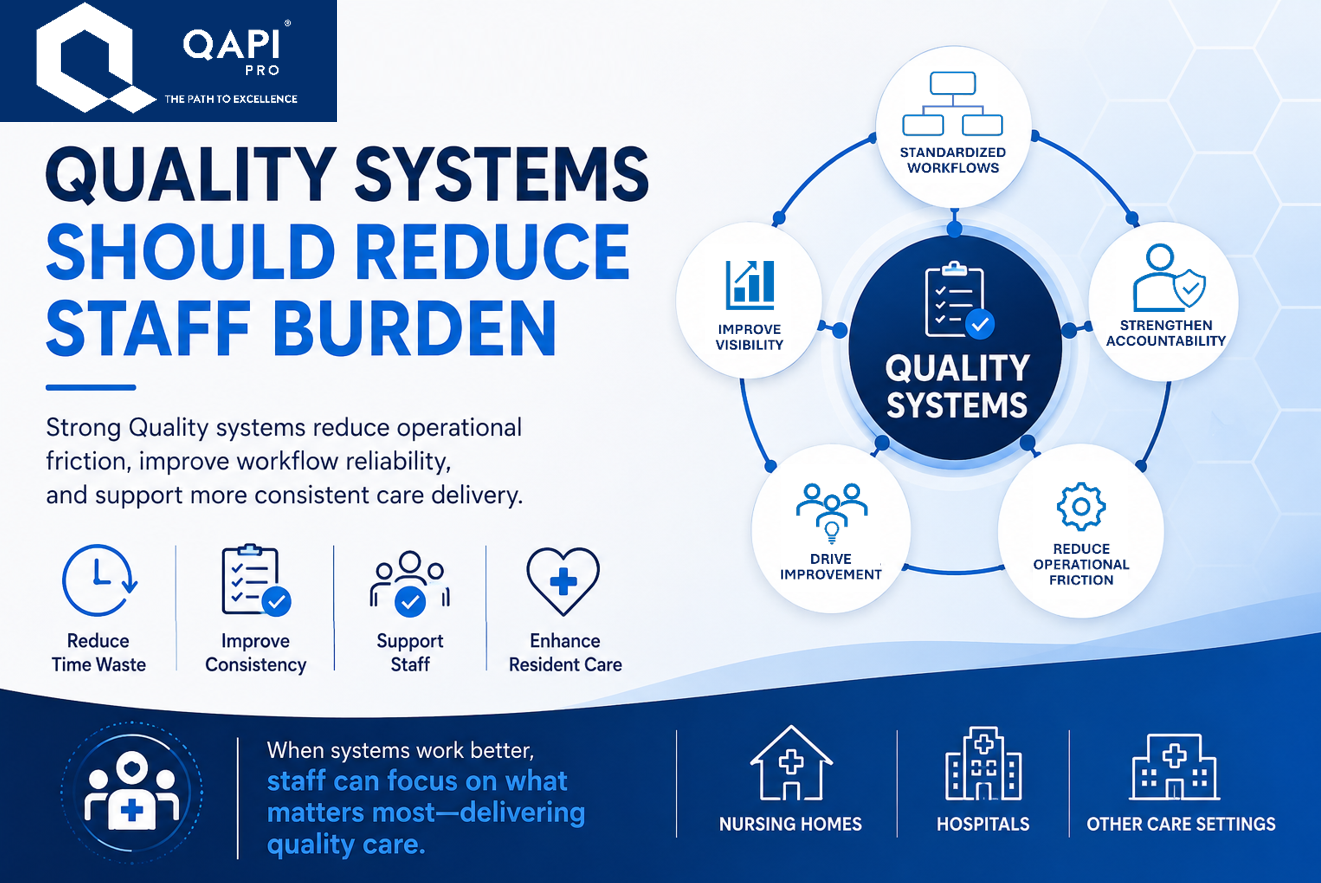
Quality Systems Should Reduce Staff Burden


Staff Burden Is Also a Systems Issue
Staffing shortages and burnout continue to place significant pressure across healthcare environments, including nursing homes, hospitals, and other care settings. Leaders feel it. Staff feel it. Residents/Patients and families often experience the consequences when routines are delayed, communication becomes inconsistent, or follow-up does not occur as expected.
But staffing pressure is not only a headcount issue. It is also a systems issue.
In many organizations, information exists, reports are generated, and meetings occur regularly — yet leadership may still lack reliable operational visibility because the underlying systems are fragmented or inconsistent.
Operational burden is often intensified by:
- Fragmented workflows
- Duplicated documentation
- Unclear expectations
- Repeated interruptions
- Manual processes that require staff to search, clarify, repeatedly re-enter information, or reconstruct what happened after the fact
These issues may appear small in isolation:
- A missing update
- A delayed follow-up
- A repeated question
- A manual report that requires interpretation
- A tracking process that depends on one person remembering to communicate the next step
Individually, these moments may not seem significant. But across departments, shifts, residents/patients, and facilities, these small disruptions become Operational Friction.
What is Operational Friction?
Operational Friction
Any unnecessary barrier, inefficiency, or system deficiency that forces staff to compensate for weaknesses in processes, communication, information, or accountability, making execution more difficult than it should be.
Staff Should Not Have to Compensate for Weak Systems
When workflows are not clearly structured, staff often compensate.
They create workarounds, rely on memory, repeat documentation, ask the same questions multiple times, and follow up manually because accountability is not consistently visible within the process.
Staff are often not only performing the work — they are compensating for the system.
This is not a staff performance issue alone. In many cases, it is a system design issue.
A strong Quality Management System should help reduce this burden by creating:
- Structure
- Visibility
- Consistency
- Reliable follow-up
- Clear accountability
Quality systems should not make daily operations more difficult.
They should make reliable execution easier and more sustainable.
A well-designed system should make it easier for:
- Staff to document information correctly
- Leaders to identify trends earlier
- Teams to follow up on issues consistently
- Organizations to reduce variation over time
Technology Is Not Automatically a Solution
Technology alone does not improve Quality.
Technology improves Quality only when it:
- Simplifies workflows
- Strengthens accountability
- Reduces variation
- Supports reliable execution
A digital tool that simply replaces a paper process without improving workflow may still leave staff burdened.
A system that requires duplicate entry may create frustration.
A platform that captures information but does not support analysis may provide documentation without meaningful insight.
A process that produces reports but does not support accountability may still fail to drive improvement.
The value of technology depends on whether it improves the way work is performed.
A Strong and Well-designed Quality Management System should be:
- Simple enough for staff to use consistently
- Standardized enough to reduce variation
- Supported enough to guide execution
- Streamlined enough to reduce unnecessary steps, duplication, and delays
QAPI Should Identify Friction, Not Only Deficiencies
Quality Assurance and Performance Improvement is often discussed in relation to:
- Compliance
- Surveys
- Corrective action
Those areas are important.
But QAPI should also help leadership identify where daily operations are breaking down.
Leadership should ask:
- Where is staff time being lost?
- Where are interruptions repeated?
- Where is documentation inconsistent?
- Where do issues require multiple follow-ups because accountability is unclear?
- Where are leaders reviewing information but still lacking reliable visibility?
These questions matter because Quality is not achieved only by responding to deficiencies.
Quality is achieved by building systems that reduce variation and support consistent performance.
Operational Friction is Measurable
Operational friction is often treated as part of normal daily operations.
Repeated interruptions, duplicated documentation, delayed follow-up, unclear accountability, inconsistent workflows, and fragmented communication become normalized over time.
But these issues are measurable.
Operational friction often reveals itself through workarounds. Every manual spreadsheet, repeated follow-up, duplicated entry, or process that depends on memory is often evidence that the system is creating unnecessary work.
They affect:
- Response times
- Documentation consistency
- Follow-up completion
- Staff workload
- Workflow reliability
- Ultimately resident/patient outcomes
A mature Quality Management System should help organizations identify these patterns early, quantify their operational impact, and implement corrective actions before the consequences become larger system failures.
The Leadership Question
When staff are overwhelmed, the first question is often:
“Do we have enough staff?”
That question is valid.
But it should not be the only question.
Leadership should also ask:
“How much staff time is being consumed by preventable friction?”
This distinction matters.
Some workload pressure may require staffing solutions. But some requires:
- Better process design
- Stronger standardization
- Clearer communication
- Improved tracking systems
- More reliable accountability structures
A strong Quality Management System connects information, accountability, follow-up, and operational visibility into one reliable structure.
Quality Systems Should Give Time Back
A strong Quality Management System should not exist as an additional burden placed on staff.
It should help remove unnecessary operational burden from daily work.
A strong system should help reduce:
- Rework
- Confusion
- Duplicated effort
- Delayed follow-up
- Communication gaps
- Dependence on memory or manual workarounds
It should also reduce the gap between what leadership believes is happening and what is actually happening in daily operations.
When systems are well designed, staff spend less time compensating for broken processes and more time focused on care.
That is the connection between:
- Quality
- Staff satisfaction
- Resident experience
- Operational reliability
QAPI is not only a regulatory requirement.
It is a framework for building more reliable operations.
And in today’s healthcare environment, reliable operations are essential.
Sustainable Quality is not created by asking staff to carry more. It is created by reducing operational friction so people can focus on the work that matters most.
Discover more interesting articles and news


