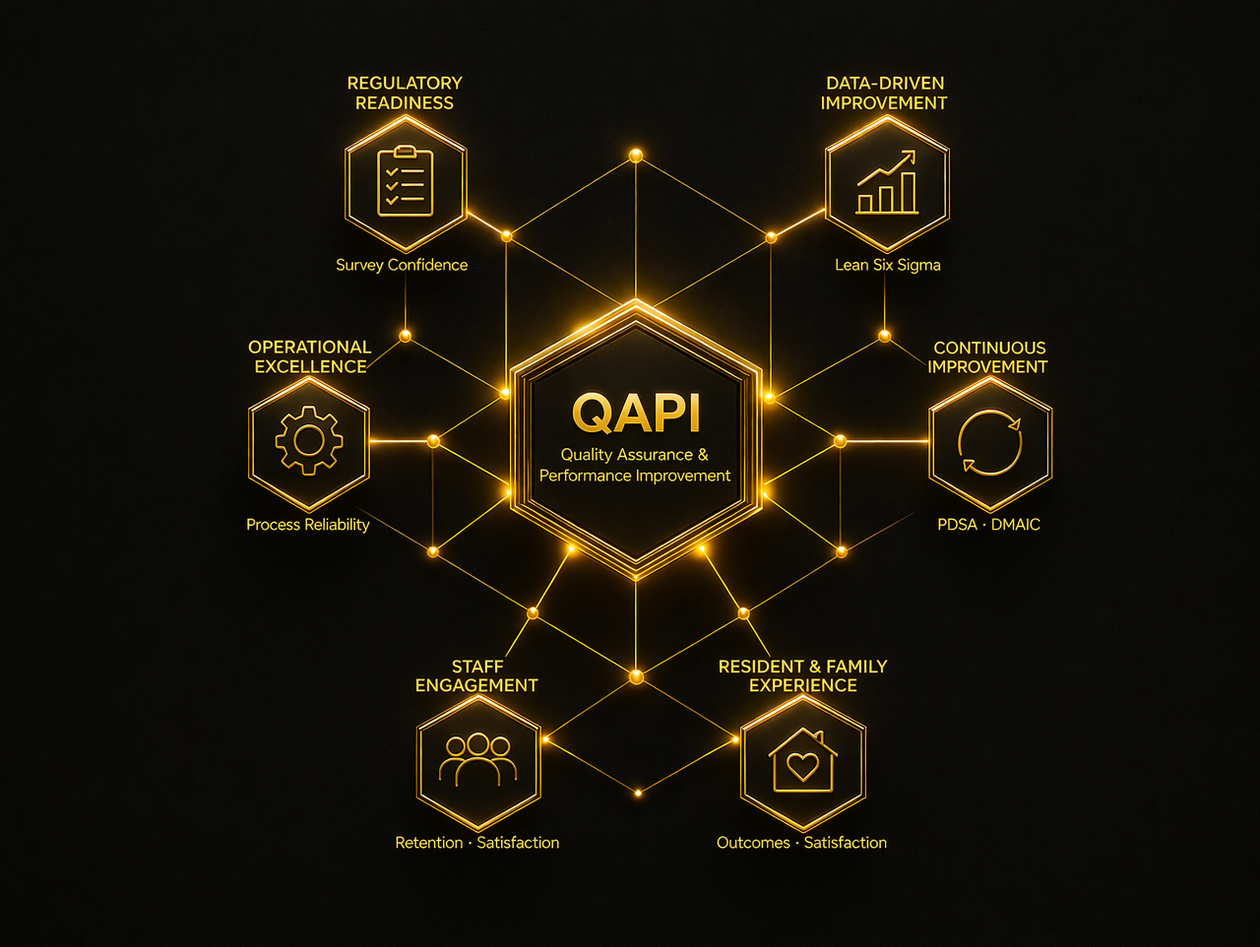
The Shift from Documentation to Operational Disciplines
As regulatory expectations continue to evolve, healthcare organizations are increasingly expected to demonstrate not only that quality activities exist, but that they produce measurable, sustained results.
This shift is reflected in several key expectations:
- Reliable data collection and validation
- Clearly defined performance improvement structures
- The ability to identify recurring deficiencies and prevent them
- Strong internal auditing and consistent follow-through
In practical terms, the focus is moving from reporting Quality to managing Quality through structured systems.
For many organizations, the challenge is not understanding these expectations. Healthcare leaders are familiar with regulatory requirements and quality frameworks.
The challenge lies in execution.
Specifically, in ensuring that QAPI programs are structured to consistently translate data, findings, and improvement initiatives into measurable operational outcomes.
Why Structure Determines Reliability
Healthcare environments are inherently complex. Clinical care, regulatory compliance, staffing dynamics, and operational demands intersect continuously.
In this context, outcomes depend less on isolated decisions and more on how consistently organizations:
- Assess
- Document
- Communicate
- Follow through
When these processes are not clearly defined, measured, and reviewed, variation becomes the norm.
Over time, that variation weakens reliability, reduces staff confidence, and negatively impacts the resident and family experience.
Strong systems do not eliminate complexity.
They make complexity manageable.
Internal Auditing as the Mechanism of Control
One of the most critical components in this transition from documentation to discipline is internal auditing.
In many organizations, auditing is associated with compliance. It is triggered by surveys, incidents, or external findings.
This reactive approach limits its impact.
Reliable organizations approach auditing differently.
They establish structured auditing and monitoring systems that continuously evaluate how work is actually performed across departments, shifts, and time.
In the nursing home environment, this includes routinely examining:
- Consistency of processes across all shifts, including nights and weekends
- Timely identification, documentation, and communication of changes in condition
- Implementation and monitoring of care plan interventions
- Alignment of staffing assignments with resident acuity
- Proactive monitoring of high-risk areas such as falls, pressure injuries, and infections
- Responsiveness to resident needs, including call systems and service delivery
- Early identification of risks before escalation into adverse events or survey citations
Internal auditing, when structured effectively, creates visibility.
It allows leadership to understand how the organization operates beyond what policies and procedures intend.
Without this visibility, organizations rely on anecdotal feedback or isolated events.
With it, patterns emerge.
Risks are identified earlier.
Improvement becomes proactive rather than reactive.
From Episodic Improvement to Continuous Reliability
When internal auditing is integrated into a structured QAPI program, its role expands.
It no longer serves only to identify problems.
It becomes a continuous feedback mechanism that supports:
- Early risk detection
- Consistent process validation
- Data-driven decision making
- Sustained follow-through
Over time, this changes how organizations improve.
Quality work shifts from episodic to continuous.
Improvement efforts accumulate rather than repeat.
And QAPI begins to function as it was intended:
Not as documentation, but as an operational system.
A Leadership Decision
High-quality outcomes are not the result of effort alone.
They are the result of disciplined systems that support consistent execution.
Moving QAPI from documentation to operational discipline is not a technical adjustment.
It is a leadership decision.
Organizations that make this shift develop the ability to understand their own systems before those systems fail.
That is what defines reliability.
That is what sustains performance.
That is how excellence is achieved.