Why Organizational Intelingence Requires Integrated Systems
Healthcare organizations collect enormous amounts of information every day.
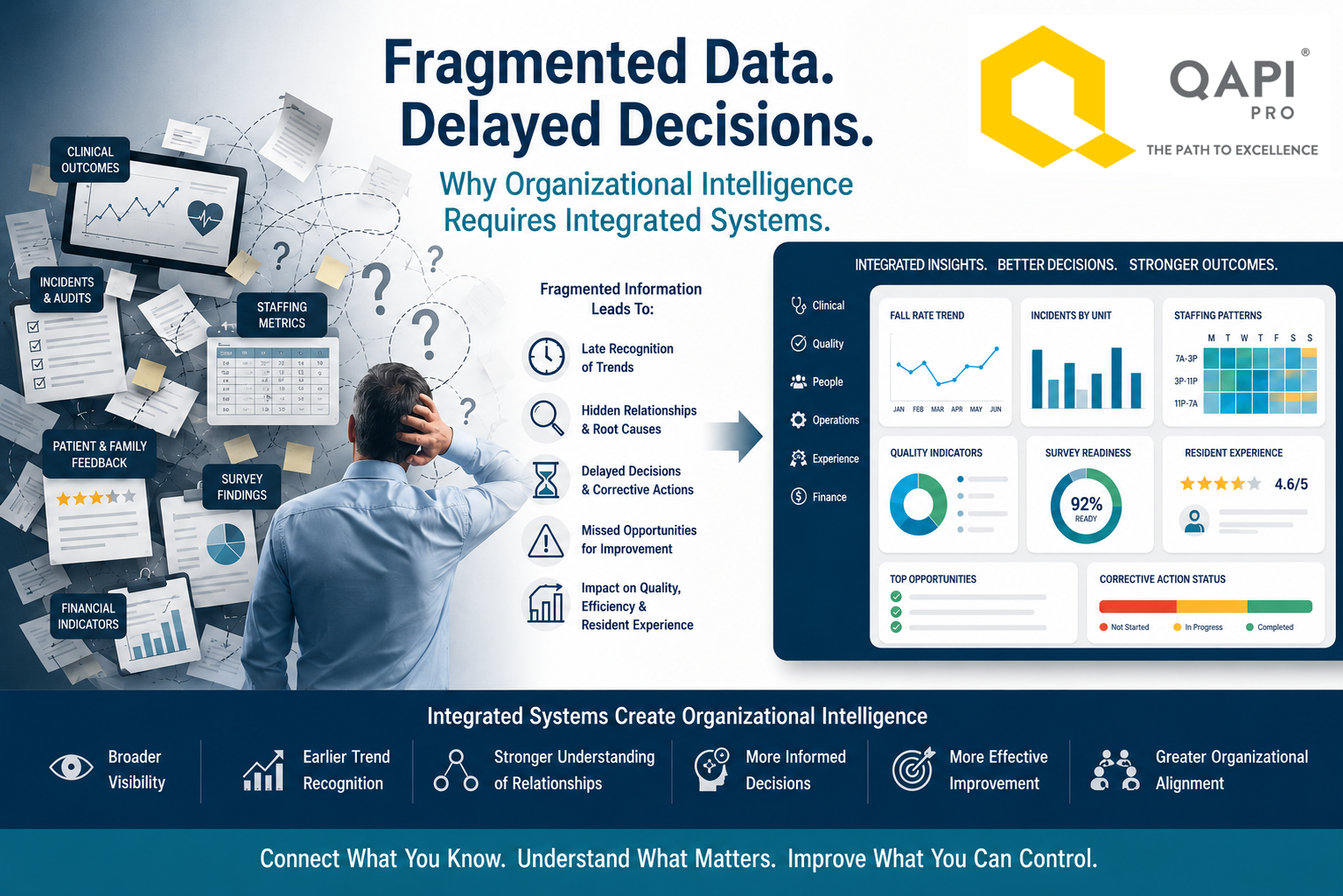
Clinical outcomes, incidents, audits, staffing metrics, customer satisfaction feedback, operational observations, survey findings, and financial indicators continuously generate data that can help leaders understand organizational performance.
Paradoxically, many organizations still struggle to answer relatively simple operational questions:
What is happening?
Where is it happening?
Why is it happening?
How frequently is it happening?
How are different issues connected?
The challenge is often not the absence of information.
It is the fragmentation of information.
When Information Exists Everywhere
Healthcare organizations have information stored across multiple departments, systems, reports, spreadsheets, and communication channels.
Each area may review its own information appropriately.
Clinical teams review clinical indicators.
Operations review operational metrics.
Human Resources review staffing information.
Quality teams review audits and incidents.
Individual departments may function reasonably well.
The difficulty emerges when information remains compartmentalized.
Organizations can possess large amounts of information and still struggle to develop a complete understanding of performance.
Why Fragmentation Delays Decisions?
Operational problems rarely originate from a single event, department, or metric.
Performance issues are frequently influenced by multiple factors occurring simultaneously.
A rise in falls, for example, may involve:
- Staffing patterns
- Communication processes
- Environmental factors
- Training opportunities
- Documentation practices
- Care planning execution
No single report may reveal the entire picture.
Leaders often need to connect information from several sources before meaningful patterns become visible.
When information remains fragmented:
- Trends become more difficult to identify.
- Relationships between issues become less visible.
- Root causes become harder to understand.
- Corrective actions may take longer to implement.
- Improvement opportunities can remain hidden.
The organization may eventually recognize the issue, but often after valuable time has already been lost.
Over time, these disconnects can create unnecessary delays, inefficiencies, and barriers to execution—conditions that contribute to what we describe as Operational Friction.
Organizational Intelingence Requires Connection
Organizational intelligence does not simply mean possessing information.
It means understanding relationships.
It means recognizing patterns.
It means seeing how operational factors influence one another.
This requires information to move beyond departmental boundaries.
Integrated systems create the conditions for leaders to:
- Develop broader visibility
- Recognize trends earlier
- Understand operational relationships
- Make more informed decisions
- Coordinate improvement efforts more effectively
- Support greater organizational alignment
From Information to Understanding
Healthcare organizations generally do not need more information.
Many already possess considerable amounts of it.
The opportunity often lies elsewhere.
The opportunity is to connect information in ways that improve understanding.
Better decisions frequently begin by connecting what the organization already knows.
Integrated systems help transform information into visibility, visibility into organizational intelligence, and organizational intelligence into more effective action.
As healthcare environments become increasingly complex, the ability to connect information may become one of the most important characteristics of high-performing organizations.