

Operational Friction in Healthcare – Part II
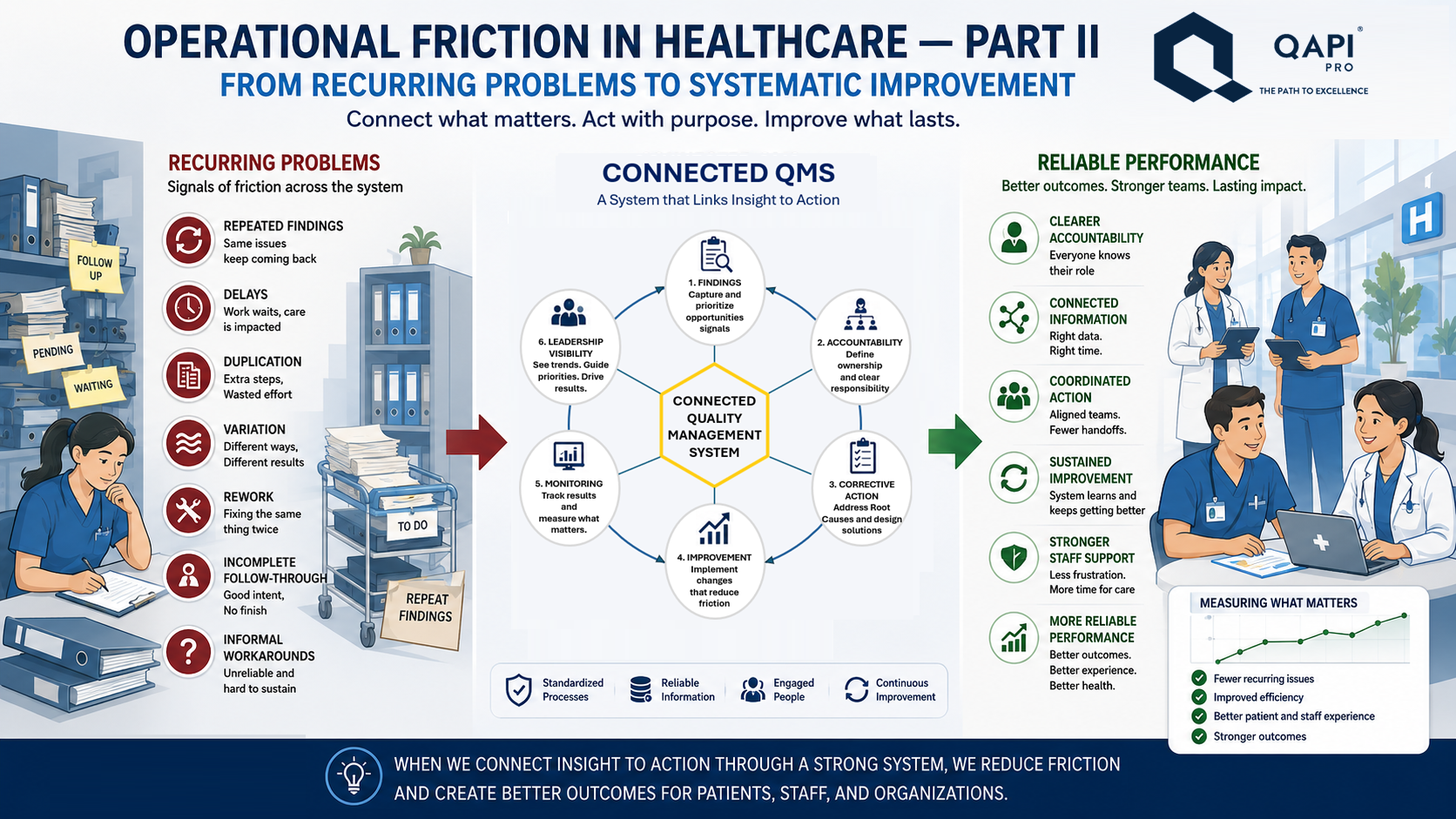


From Visibility to Systematic Improvement
Recognizing operational friction is only the beginning.
Once recurring barriers become visible, the organization must understand what is producing them, how they are connected, and what needs to change to make reliable execution easier to sustain.
That requires more than responding to individual events. It requires a connected system for managing Quality across the organization, bringing together findings, accountability, corrective action, improvement, monitoring, and leadership oversight.
That is the role of a Quality Management System.
Look for Patterns, Not Isolated Events
Operational friction is rarely understood through one event alone.
A delayed action, incomplete document, communication breakdown, or missed task may be an isolated occurrence. When similar problems continue to appear, however, the pattern becomes more important than the individual event.
Leaders should pay attention when:
- The same or similar findings repeatedly return.
- Corrective actions remain open beyond expected timelines.
- Related concerns are being managed independently across departments.
- Staff repeatedly enter the same information or rely on manual workarounds.
- Processes depend on reminders or repeated leadership follow-up.
- Actions are completed without evidence that the underlying problem was resolved.
Recurring problems are not simply isolated operational failures. They are system signals.
Recurring problems may indicate weaknesses in a process, information pathway, accountability structure, technology, or decision mechanism. Identifying those patterns gives leaders the opportunity to address the conditions producing the friction rather than repeatedly responding to its symptoms.
Distinguish the Event from the System Condition
A visible problem is not always the complete problem.
Incomplete documentation may reflect a poorly designed workflow.
Delayed follow-up may reflect fragmented tracking or unclear ownership.
Repeated retraining may indicate that the process itself remains difficult to execute.
Overdue corrective actions may reflect limited visibility or unclear accountability rather than lack of effort.
The event is what happened. The system’s condition helps explain why it happened and why it may happen again.
This distinction matters because an organization can correct the immediate event while leaving the underlying condition unchanged.
The documentation may be completed. The concern may be addressed. The employee may be retrained. The report may be submitted.
But if the workflow, information flow, ownership, technology, or monitoring structure remains unchanged, the friction remains.
The question is not only: What went wrong?
It must also become: What within the system made the problem possible, and what continues to make reliable execution difficult?
A connected Quality Management System helps organizations examine both the individual event and the broader conditions that may be allowing similar problems to recur.
Measure the Signals of Operational Friction
Operational friction may not be represented by one universal score, but its effects can be identified through recurring operational signals.
- Recurrence: How often does the same or a related concern return? Repeated findings, reopened issues, or recurring education may indicate that the event is being corrected without changing the underlying condition.
- Delay: How long does it take to move from identification to assignment, action, escalation, and verification? Excessive delay may reveal unclear ownership, information gaps, competing priorities, or decision barriers.
- Duplication: Where are staff repeating work without adding value? Parallel tracking, duplicate documentation, and repeated requests for the same information consume time and increase inconsistency.
- Variation: How differently is the same process performed across departments, shifts, or individuals? Necessary clinical variation should be distinguished from uncontrolled variation caused by unclear expectations, workflows, or responsibilities.
- Rework: How often must work be corrected, repeated, or reopened? Rework can signal incomplete information, poor handoffs, unclear requirements, or weak process design.
- Incomplete Follow-Through: How often are actions initiated without clear closure or verification? An action may be marked complete even though the underlying problem remains or effectiveness has not been demonstrated.
Together, these signals help leaders identify where the system may be creating unnecessary barriers to reliable execution.
The objective is not to create another set of disconnected metrics. It is to connect operational evidence within the Quality Management System so leaders can understand where execution repeatedly slows, fragments, varies, or fails, and determine whether improvement is actually occurring.
What a Quality Management System Enables
A Quality Management System does more than document Quality activity.
A well-designed QMS connects findings, risks, corrective actions, improvement activity, accountability, monitoring, and leadership oversight so the organization can understand how those elements relate to one another.
That connected structure enables leaders to:
- Identify recurring patterns.
- Connect related concerns across departments.
- Clarify ownership and expectations.
- Coordinate corrective action and improvement.
- Monitor progress and verify effectiveness.
- Maintain leadership visibility and sustain improvement over time.
Without that structure, Quality activity may remain dispersed across audits, reports, spreadsheets, meetings, email, and separate tracking processes.
Each activity may exist, but the relationships between them can remain difficult to see.
The value of a QMS is not simply that it stores information. Its value is that it enables the organization to manage the relationships between problems, actions, responsibilities, and results.
This is what moves Quality from isolated activity toward coordinated management.
Match the Response to the System Condition
Once operational friction becomes visible, the response should be disciplined.
Reducing friction requires the organization to identify the barrier, understand the contributing conditions, connect relevant information, adjust or redesign the process when necessary, monitor the response, and verify that improvement is sustained.
Not every problem requires another training session.
Not every visibility issue requires another report.
Not every delay requires another reminder.
The response should match the condition creating the friction.
If ownership is unclear, clarify it.
If information is fragmented, improve how it is connected.
If the workflow is unnecessarily complex, simplify it.
If technology creates duplication, redesign how it supports the process.
If monitoring confirms completion but not effectiveness, strengthen verification.
The strongest corrective action addresses the system condition that makes reliable execution difficult.
Leadership Responsibility
Operational friction is not only a frontline issue.
Leaders influence the processes, accountability structures, information pathways, priorities, and management systems through which work is performed.
A useful leadership review should ask:
- Are recurring concerns connected or reviewed as separate events?
- Are staff repeatedly compensating for known barriers?
- Can leadership clearly see ownership, progress, and effectiveness?
- Are corrective actions addressing underlying system conditions or simply closing the event?
- Are improvements sustained after formal monitoring ends?
These questions shift leadership attention from activity completion toward system performance.
From Friction to Reliable Performance
Healthcare will always involve complexity.
Multiple disciplines must coordinate, regulatory requirements must be met, priorities change, and decisions often need to be made quickly.
The objective is not to eliminate complexity. It is to remove the unnecessary barriers that make complexity harder to manage.
Delay, duplication, variation, rework, incomplete follow-through, and repeated workarounds are not merely inconveniences. They are operational evidence.
When leaders connect that evidence, understand the system conditions involved, act on those conditions, and verify effectiveness, operational friction becomes manageable.
Reliable performance is not achieved by asking people to work harder around fragmented systems.
It is built when organizations can see the barriers affecting execution, connect the information surrounding them, address the underlying conditions, and verify that improvement is sustained.
A well-designed Quality Management System turns operational evidence into coordinated action, accountability, and sustained improvement.
Discover more interesting articles and news


