

Operational Friction in Healthcare – Part I
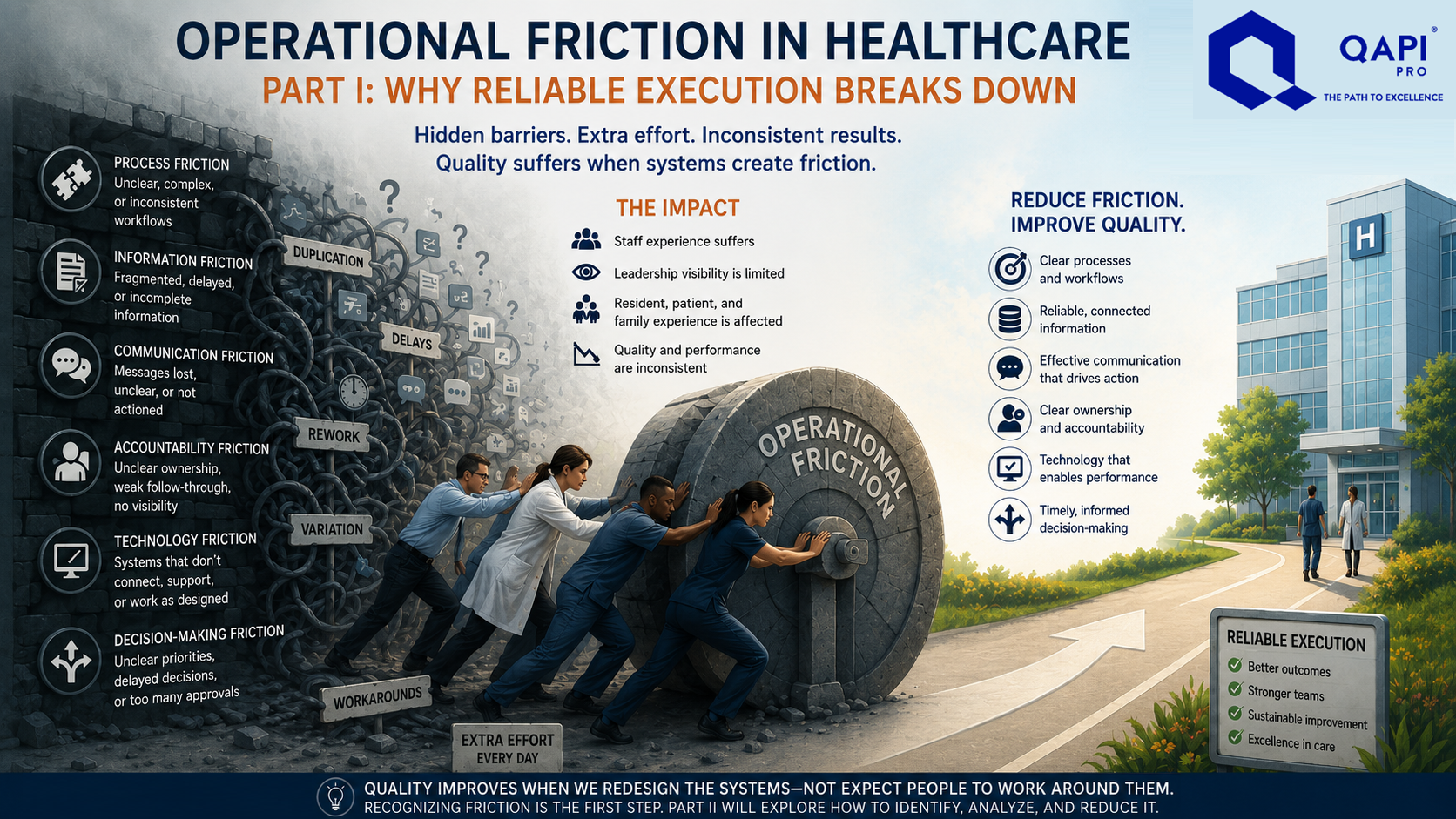


Why Reliable Execution Breaks Down
Healthcare organizations often experience the same concerns returning even after policies are reviewed, staff are educated, corrective actions are completed, and monitoring is conducted. When execution remains inconsistent despite these efforts, the issue may not be a lack of commitment or activity, but the presence of underlying barriers that make reliable performance difficult to sustain.
In healthcare, where operations are complex, interdisciplinary, highly regulated, and time-sensitive, even small barriers can accumulate. Over time, they consume capacity, delay decisions, increase variation, frustrate staff, weaken leadership visibility, and make sustainable improvement more difficult.
These conditions create operational friction. Reducing that friction is not simply an efficiency initiative. It is a Quality Management responsibility.
What is Operational Friction?
Operational friction is the accumulation of barriers within processes, information flow, communication, accountability, technology, and decision-making that interfere with an organization’s ability to execute work consistently and effectively.
It rarely appears as one major failure. More often, it develops through smaller barriers distributed across departments, workflows, and systems.
Examples include:
- A process that requires information from several disconnected sources.
- A corrective action that depends on repeated manual follow-up.
- An audit finding that is not connected to similar findings elsewhere in the organization.
- A policy that defines expectations but does not establish how implementation will be monitored.
- A report that presents data without showing ownership, progress, or effectiveness.
- A task that is performed differently depending on the shift, department, or individual involved.
- A known system limitation that staff routinely manage through informal workarounds.
Operational friction does not necessarily stop the work. Employees invest additional time, attention, and effort to keep processes moving. Experienced staff learn how to navigate unclear workflows. Leaders remember which actions require follow-up. Employees know whom to contact when the formal pathway does not work.
That additional effort can conceal weaknesses in the underlying system.
A process may appear functional because an experienced employee knows how to manage it. A corrective action may appear controlled because one leader consistently follows up. Information may eventually reach the right person because staff rely on personal relationships and informal communication.
However, a system that depends on memory, persistence, and workarounds is not reliably controlled.
Commitment Is Necessary, but It Is Not Enough
Consider recurring documentation omissions in the electronic medical record. The organization reviews the documentation requirements, retrains staff, and increases auditing. Performance may improve temporarily, but the omissions later return.
At that point, leaders may conclude that employees are not following established expectations. In some cases, that may be true. However, the explanation may also be incomplete.
The required information may be documented in several sections of the EMR. The workflow may not align with the actual sequence of care. Staff may be uncertain about which discipline is responsible for entering or verifying the information. Alerts may be unclear or easily overlooked. Different departments may provide inconsistent direction, or audit findings may not reach the individuals with the authority to redesign the process.
In that situation, additional education alone will not resolve the concern. The organization has addressed knowledge and expectations, but not the operational conditions contributing to the omissions.
Commitment matters. Accountability matters. Competence matters. However, none of them can permanently compensate for systems that make reliable documentation harder than it should be.
When omissions continue despite repeated interventions, leaders must examine not only whether staff followed the process, but also whether the process, technology, and accountability structure support reliable execution.
Where Operational Friction Appears
Operational friction can emerge in every area of healthcare operations. Although the categories frequently overlap, examining them separately helps leaders understand where barriers are forming.
Process Friction
Process friction exists when workflows are unclear, unnecessarily complex, inconsistent, or poorly connected.
It may appear when departments follow different versions of the same process, responsibilities change depending on who is working, or unnecessary approvals and handoffs delay completion.
Over time, steps may be added without evaluating the workflow as a whole. The process becomes harder to understand and more dependent on individual interpretation.
When the correct pathway is not simple, visible, and consistently understood, variation increases.
Information Friction
Information friction occurs when relevant information is fragmented, delayed, duplicated, incomplete, or difficult to access when decisions must be made.
An organization may have substantial amounts of data and still lack operational visibility.
Audit results may remain in separate files. Corrective actions may be tracked independently from the findings that initiated them. Meeting decisions may not be connected to implementation records. Leaders may review several reports to understand one operational issue.
The problem is not always the absence of information. It is the inability to connect the right information at the right time for the right decision.
More data does not automatically create greater visibility.
Communication Friction
Communication friction develops when important information does not move reliably between individuals, shifts, departments, or levels of leadership.
It may appear when handoffs omit essential details, staff are uncertain about when or to whom a concern should be escalated, different departments receive inconsistent instructions, or follow-up depends on email chains, verbal reminders, and personal memory.
These breakdowns are not always caused by communication skills alone. They may also reflect unclear ownership, inadequate documentation processes, disconnected systems, undefined escalation expectations, or the absence of a reliable method for tracking follow-up.
When the surrounding structure is unclear, repeated reminders to “communicate better” will not create consistent information flow.
Accountability Friction
Accountability friction exists when ownership is unclear, responsibilities overlap, deadlines are not visible, or follow-through depends on repeated informal follow-up.
Several people may be involved, but no one may be clearly accountable for the final result. Actions may be assigned without defined completion criteria. Activities may be marked complete without verifying whether they were effective.
Accountability is not created simply by assigning a name to a task.
Effective accountability requires clear ownership, defined expectations, timelines, visibility, and verification.
Technology Friction
Technology friction occurs when digital tools, systems, or applications create additional work, fail to support the actual operational process, or prevent relevant information from being connected and used effectively.
It may also occur when systems such as an electronic medical record lack the functionality, workflow design, alerts, reporting capabilities, or audit features needed to support the professionals who rely on them.
Examples include duplicate data entry, disconnected applications, difficult-to-retrieve information, reports that require extensive manual preparation, limited audit capabilities, and insufficient tools for analyzing trends across different operational or clinical areas.
Technology can reduce friction, but technology alone does not create an effective Quality Management System.
A poorly designed digital process can reproduce the same fragmentation that existed before automation—or create new barriers within the workflow.
The central question is not whether an organization uses paper, spreadsheets, or software. It is whether its tools support connected, visible, and accountable execution.
Decision Friction
Decision friction exists when action is delayed because information, authority, priorities, or escalation requirements are unclear.
Leaders may lack timely access to relevant information. Staff may be uncertain about who has the authority to act. Several committees may review the same concern independently. Data may be available, but the action required may not be clear.
In healthcare, delays in decision-making can affect safety, compliance, staffing, service delivery, and resident or patient outcomes.
Why Recurring Problems Continue
Recurring problems are among the clearest signs that operational friction may be present.
A problem may initially be treated as an isolated event. Leaders respond, corrective actions are developed, improvement projects are initiated, and monitoring begins. Performance may improve temporarily.
Then the problem returns.
The recurrence often produces another round of education, auditing, counseling, or policy review. Although these actions may address the immediate risk, they may not change the conditions that made recurrence likely.
Examples include:
- Staff are retrained, but the workflow remains confusing.
- A policy is revised, but responsibilities remain unclear.
- An audit identifies noncompliance, but related findings are not connected.
- A corrective action is closed, but its effectiveness is not evaluated.
- A process is monitored temporarily and then returns to its previous condition.
- A department resolves its portion of the issue, but the problem extends across organizational boundaries.
Correcting the visible event without changing the conditions that produced it allows recurrence to remain likely.
Recurring problems should therefore not be viewed only as repeated failures. They are also valuable information.
They may indicate that the organization has not yet fully understood the system surrounding the issue.
Operational Friction Is a Quality Management Issue
Quality Management must help an organization do more than determine whether requirements are being met. It must also help the organization understand:
- Why performance varies.
- Why the same problems return.
- Which system conditions increase risk.
- Where accountability becomes unclear.
- Whether corrective actions and improvement projects are implemented as intended.
- Whether interventions produce the expected results.
- Whether improvement is sustained.
- Whether leaders have sufficient visibility to act.
A finding may identify that a requirement was not met.
Quality Management must help the organization determine why execution failed, what factors contributed, what action is necessary, who is accountable, how progress will be monitored, and whether the response produced lasting improvement.
This requires more than a collection of audits, reports, meetings, corrective-action plans, and improvement projects. It requires a connected management structure.
When Quality activities remain fragmented, operational friction can increase.
An audit finding may be recorded in one place. The corrective action may be tracked somewhere else. Implementation may be discussed in a meeting. Supporting documentation may remain in email. Progress may be presented through a separate report. Effectiveness may never be formally connected to the original concern.
Every component may exist, yet leadership may still lack a complete view of the issue, the actions taken, the progress achieved, and whether the response was effective.
The presence of Quality activity does not automatically mean that Quality is being managed as a system.
A Quality Management System is the connected structure through which an organization manages Quality across its operations. It brings together monitoring, accountability, corrective action, performance improvement, documentation, and leadership oversight so Quality is managed continuously rather than through disconnected activities.
A well-designed Quality Management System creates the structure needed to connect those activities. It enables leaders to see how findings, corrective actions, improvement projects, accountability, monitoring, and results relate to one another. That connected visibility helps the organization identify patterns, coordinate action, verify effectiveness, and sustain improvement rather than repeatedly managing each concern as an isolated event.
The Organizational Impact
Operational friction affects more than efficiency.
For staff, it creates unnecessary work through repeated searches for information, duplicated tasks, unclear instructions, and the need to compensate for unreliable processes.
For leaders, it limits visibility by leaving important relationships hidden across separate reports, departments, and systems.
For residents, patients, and families, its effects become visible through delays, communication gaps, and inconsistent follow-through at the point of care and service.
Residents, patients, and families do not experience departments separately. They experience the combined result of how the organization functions.
Operational friction may originate inside an administrative process, but its consequences can extend throughout the organization.
Making Operational Friction Visible
Operational friction may seem abstract, but its effects can be observed.
It often becomes visible through patterns such as:
- Recurrence.
- Delay.
- Duplication.
- Rework.
- Variation.
- Incomplete follow-through.
- Unnecessary transfers of responsibility.
- Repeated clarification.
- Unresolved ownership.
- Dependence on workarounds.
These patterns do not automatically prove that operational friction is the cause. They indicate where leaders should look more closely.
The objective is not to eliminate every difficulty from healthcare operations. Complexity, competing priorities, and unexpected conditions will always exist.
The objective is to reduce the unnecessary barriers that consume capacity without improving care, service, compliance, or performance.
That requires organizations to move beyond isolated outcomes and examine the system conditions surrounding them.
Quality improves when organizations stop expecting people to work around broken connections and begin redesigning the systems through which performance is achieved.
Recognizing operational friction is the first step. In the next article in this series, we will examine how healthcare organizations can identify its underlying conditions, measure its effects, and systematically reduce the barriers affecting reliable performance
Discover more interesting articles and news


